
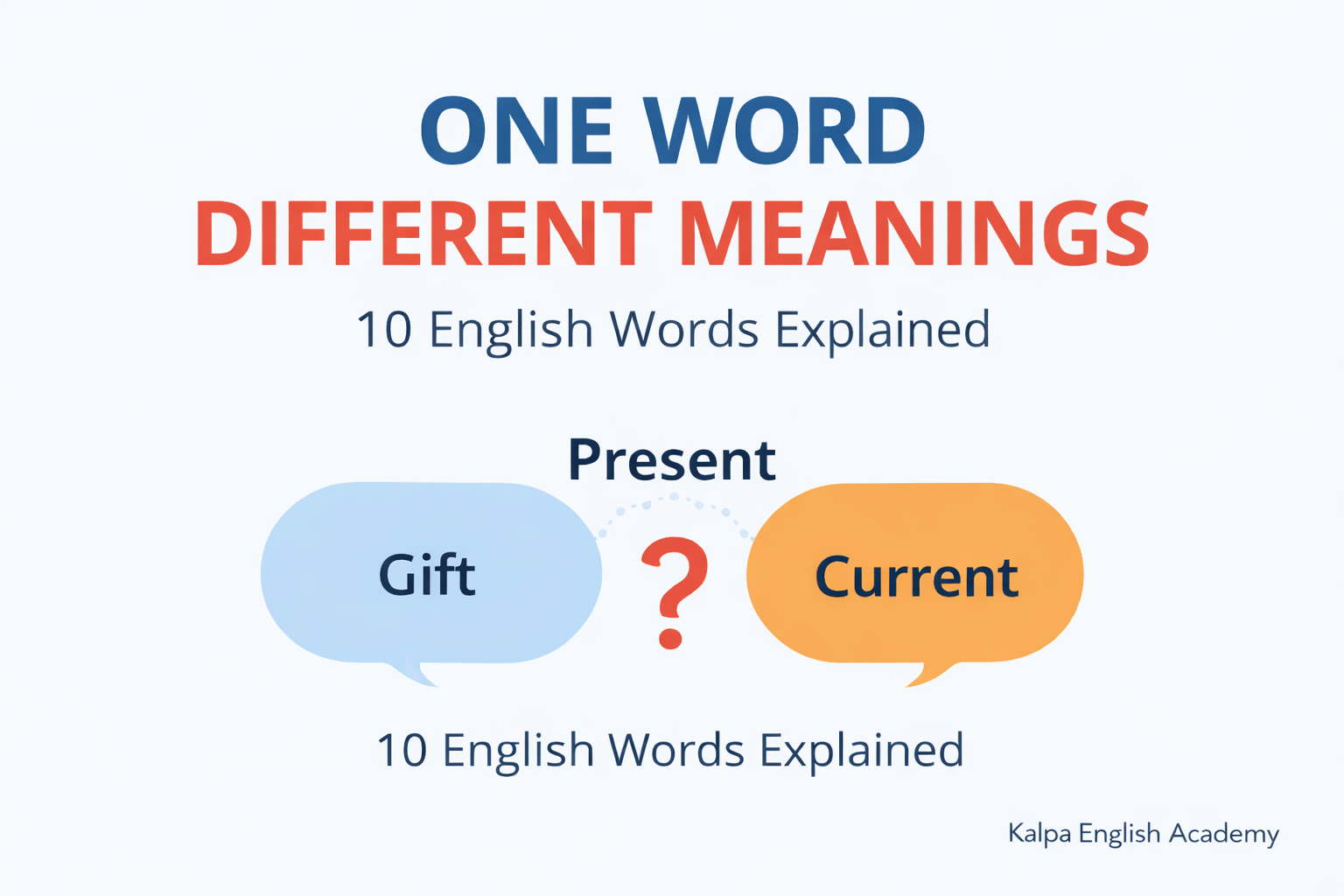
One Word, Different Meanings: 10 English Words That Confuse Many Learners
(A Practical Vocabulary Guide for Students & Working Professionals)
Introduction
Many English learners feel confident with grammar rules but still struggle while reading newspapers, official emails, or listening to formal speeches. One common reason for this confusion is that the same English word can have different meanings in different situations.
English words with different meanings often confuse learners, especially when reading news articles, office emails, and formal English.
English is a context-based language. A word does not always carry the same meaning everywhere. Understanding this idea is very important for learners who want to move from basic English to fluent, professional English.
In this blog post, we will look at 10 commonly used English words that have more than one meaning. Each word is explained with simple meanings and examples so that learners can clearly understand how context changes meaning. This lesson is especially useful for Level 2 and Level 3 learners, job seekers, and working professionals.
Learning English words with different meanings helps students and working professionals understand real-life English more clearly.
1. August
Meaning 1 (Adjective): respected / dignified
The august House of Parliament discussed the bill seriously.
Meaning 2 (Noun): the month of August
The annual meeting will be held in August.
📌 Note: When “August” is capitalized, it usually refers to the month.
2. Minute
Meaning 1 (Adjective): very small
Please check the minute details before submitting the report.
Meaning 2 (Noun): sixty seconds
I will join the call in a minute.
📌 Pronunciation changes with meaning, which often confuses learners.
3. Object
Meaning 1 (Noun): a thing
There is a sharp object on the floor.
Meaning 2 (Verb): to oppose or disagree
I strongly object to this proposal.
📌 Grammar tip: Verb form usually comes after the subject.
Also check
How to Practice English Fluency for 15 Minutes a Day
How to Improve English Fluency Without Memorising Rules
20 Useful English Questions You Can Use Every Day (Tamil Meaning Inside)
4. Present
Meaning 1 (Noun): a gift
She received a present from her colleagues.
Meaning 2 (Adjective): current
The present situation requires immediate action.
📌 Context decides whether it is about time or a gift.
5. Record
Meaning 1 (Noun): official information stored
This file is an important record.
Meaning 2 (Verb): to capture or store information
Please record today’s meeting.
📌 Often used in offices, meetings, and legal contexts.
6. Refuse
Meaning 1 (Verb): to say no
He refused to accept the offer.
Meaning 2 (Noun): waste or garbage
Do not throw refuse near the building.
📌 Same spelling, different pronunciation and meaning.
7. Close
Meaning 1 (Verb): to shut
Please close the window before leaving.
Meaning 2 (Adjective): near
Her house is close to the office.
📌 Very common in daily spoken and office English.
8. Lead
Meaning 1 (Verb): to guide
She will lead the team during the project.
Meaning 2 (Noun): main or principal
He played the lead role in the drama.
📌 Widely used in leadership and corporate communication.
9. Wind
Meaning 1 (Noun): moving air
The wind is strong today.
Meaning 2 (Verb): to move in a curved way
The road winds through the hills.
📌 Commonly seen in descriptive and news English.
10. Content
Meaning 1 (Noun): information or material
The content of the course is well designed.
Meaning 2 (Adjective): satisfied
She feels content with her progress.
📌 Very important word for digital, academic, and workplace English.
Why Learning Such Words Is Important
Understanding words with multiple meanings helps learners:
- Read newspapers and articles confidently
- Understand office emails and meeting discussions
- Improve vocabulary depth naturally
- Reduce hesitation while speaking English
This skill is a key step from basic English to fluent, real-life English.
Common Mistakes Learners Make
Many learners try to memorize meanings of words without paying attention to context. They assume that one word always has one fixed meaning. Because of this, they get confused while reading newspapers, listening to speeches, or participating in office discussions.
For example, when learners see a familiar word in an unfamiliar situation, they often translate it directly instead of understanding how it is being used. This habit slows down comprehension and reduces confidence while speaking. The solution is simple: observe how the word is used in the sentence before deciding its meaning.
Final Thought
To improve English, memorizing grammar rules alone is not enough. Learners must develop context awareness. When you understand how meaning changes with situation, English becomes clearer and more enjoyable.
If you want to learn practical English that works in real life, continue following lessons from Kalpa English Academy.