
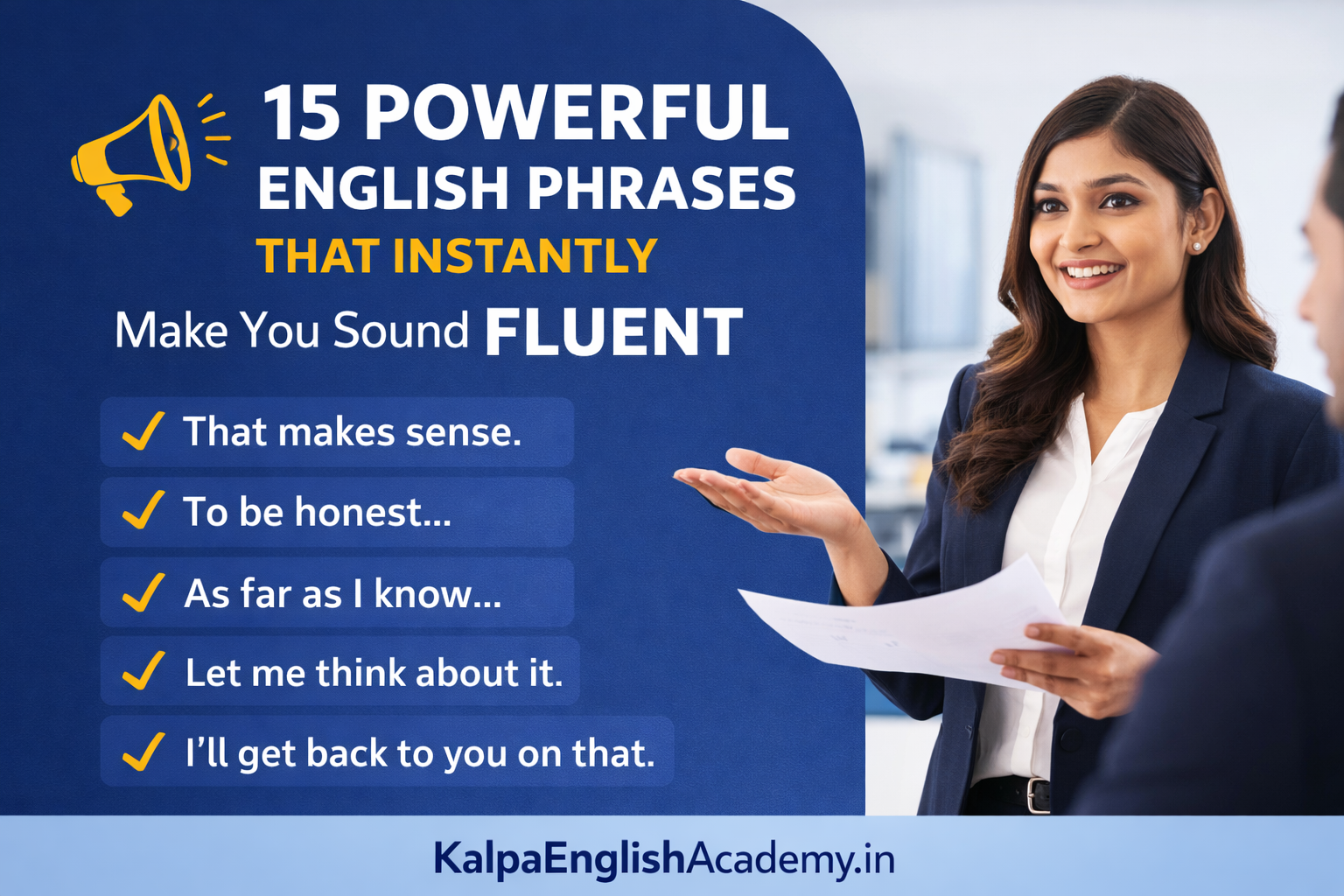
15 Powerful English Phrases That Instantly Make You Sound Fluent
English fluency phrases help you speak confidently, naturally, and without hesitation in real-life conversations.
Many English learners believe that fluency comes from learning thousands of words or memorising complicated grammar rules. While vocabulary and grammar are important, they are not the real secret of fluency.
If you closely observe fluent English speakers, you’ll notice something interesting:
They don’t search for words or mentally construct sentences every time they speak. Instead, they rely on natural, ready-made phrases that help their speech flow smoothly.
In this blog post, you’ll learn 15 powerful English phrases that can instantly improve how fluent, confident, and natural you sound in daily conversations, professional discussions, interviews, and meetings.
Why Learning Phrases Is the Smartest Way to Become Fluent
Words are like bricks.
Grammar is the cement.
But phrases are complete blocks that save time and mental effort.
When you speak using phrases:
- You reduce hesitation
- You avoid common mistakes
- You sound more natural and confident
That’s why fluent speakers think in chunks of language, not individual words. Let’s explore some of the most powerful phrases you can start using today.
1. “That makes sense.”
Use this to show understanding and agreement.
Example:
“Yes, that makes sense. I understand your idea clearly now.”
2. “To be honest…”
Introduces a genuine opinion or feeling.
Example:
“To be honest, I was nervous before my first presentation.”
3. “As far as I know…”
Perfect for sharing information politely and carefully.
Example:
“As far as I know, the class starts at 7 PM.”
4. “I see what you mean.”
Shows active listening and emotional intelligence.
Example:
“I see what you mean, but we may need another solution.”
5. “Let me think about it.”
A confident pause instead of fillers like “uh” or “hmm”.
Example:
“That’s an interesting question. Let me think about it.”
6. “From my point of view…”
Sounds structured and professional while sharing opinions.
Example:
“From my point of view, communication plays a major role in teamwork.”
7. “What I mean is…”
Helps you clarify your thoughts smoothly.
Example:
“What I mean is, we should focus on long-term improvement.”
8. “I couldn’t agree more.”
A strong and fluent way to agree completely.
Example:
“Exactly! I couldn’t agree more.”
9. “That depends.”
Short, natural, and very native-like.
Example:
“That depends on your schedule and priorities.”
10. “At the end of the day…”
Used to summarise or conclude your point confidently.
Example:
“At the end of the day, regular practice makes all the difference.”
11. “If you ask me…”
A casual and fluent way to give personal opinions.
Example:
“If you ask me, consistency is more important than speed.”
12. “I’m not sure, but…”
Polite and fluent when you’re uncertain.
Example:
“I’m not sure, but I think the deadline is next Friday.”
13. “That’s a good point.”
Shows respect and appreciation for others’ ideas.
Example:
“That’s a good point. I hadn’t thought about it that way.”
14. “Let’s put it this way…”
Sounds advanced and confident while explaining ideas.
Example:
“Let’s put it this way—confidence comes from daily usage.”
15. “I’ll get back to you on that.”
A professional alternative to saying “I don’t know.”
Example:
“I’ll check the details and get back to you on that.”
Recommended Reading
How to Practice English Fluency for 15 Minutes a Day
How to Improve English Fluency Without Memorising Rules
The Easiest Daily English Practice Method: 15 Minutes a Day
Simple grammar tips for beginners – English learning guide
How to Practise These Phrases for Real Fluency
Learning phrases is easy. Using them naturally is the real challenge.
Follow this simple and effective method:
- Choose 2 or 3 phrases per day
- Make your own sentences
- Use them in real conversations
- Repeat them until they feel automatic
Avoid memorising all 15 phrases at once. Fluency grows through daily application, not pressure.
Common Mistake Learners Make
Many learners know good phrases but hesitate to use them because of fear of mistakes. Remember this:
fluency improves only when you speak, not when you stay silent.
Mistakes are part of the learning process. Every fluent speaker was once a learner too.
Final Thoughts
Fluency is not about speaking fast or using difficult words.
It’s about speaking naturally, confidently, and comfortably.
When you start using these phrases regularly, you’ll notice:
- Less hesitation
- Better confidence
- More positive reactions from listeners
Remember:
Vocabulary gives you words
Grammar gives you accuracy
Phrases give you fluency
Start today—one phrase, one conversation, one confident step forward. 💬✨